
Every article on outsourcing Revit modelling opens the same way: hiring in-house BIM staff is expensive, outsourcing is cheaper, here’s a table comparing salaries to service fees. It’s not wrong, exactly. It’s just not the reason most firms actually end up outsourcing.
Talk to a project manager who outsourced their first Revit model and ask why, and cost rarely comes up first. What comes up is a Tuesday afternoon three weeks before a submission deadline, when the client adds two floors to the scope and the in-house BIM tech is already booked solid on another job. Or it’s a firm that just won a project twice the size of anything they’ve handled before, and doesn’t have the bandwidth to staff up for six months only to scale back down after handover. That’s not a budgeting problem. That’s a capacity problem, and it behaves differently.
Capacity problems don’t wait for your hiring cycle
An in-house team is a fixed asset. You size it for your average workload, which means it’s either underused in slow months or completely swamped when three projects land at once and in this industry, they always land at once. Nobody wins a steady, evenly-spaced stream of contracts.
Outsourcing works because a modelling partner isn’t sized around your workload, they’re sized around dozens of firms’ combined workload, which smooths out a lot faster than any single practice’s pipeline does. When your capacity spikes, theirs barely notices. That’s the actual mechanism, and it’s why “we save money” undersells what’s happening. You’re not buying cheaper hours. You’re buying elasticity you can’t build in-house without over-hiring for the good months.
The quality objection, and why it’s usually about process, not skill
The pushback we hear most from architects who haven’t outsourced yet isn’t about price; it’s “will they understand how we work?” Fair question. A model built to LOD 300 with no regard for how your team names families or structures worksets is going to cause more friction than it saves, even if the geometry is technically perfect.
This is solvable, but only if the outsourcing relationship is treated as a workflow integration, not a one-off transaction.
That means a shared template or standards document up front, a defined review cycle (not “send files, receive files, hope for the best”), and someone on the vendor side who’s answerable when clash detection turns up a coordination issue at 4pm before a Friday deadline.
Structured information management standards like ISO 19650 help here too, not because the acronym itself means anything to a client, but because a partner working to that framework has already agreed on naming conventions, model structure and version control before your first file lands in their inbox, instead of improvising it project by project. Firms that skip this step and just email a set of drawings to the lowest bidder are the ones who end up with cautionary-tale stories about outsourcing.
Firms that treat it as a process tend not to go back to hiring in-house.
Where the actual savings live
The cost savings are real, they’re just not the headline. They show up in three places:
No idle overhead. You’re not paying a BIM modeller’s salary during the weeks when there’s nothing to model. That gap is more common than people admit most practices don’t have year-round, full-time need for a dedicated Revit position, they just don’t want to say so out loud in a staffing meeting.
No software or hardware ramp-up. Revit, plus the plugins most serious modelling work needs (Navisworks for clash detection, Recap for point cloud processing if you’re working from laser scans), plus a machine that can actually run it without choking on a large federated model that’s a real capital outlay for one seat that might sit unused half the year.
No training lag on new project types. If your firm has never modelled a hospital or a historic renovation with irregular geometry, your in-house team is learning on your client’s clock. A modelling partner who’s already done a dozen of those has the muscle memory already, and it shows in the turnaround time as much as the accuracy.
When outsourcing is genuinely the wrong call
We’ll say this plainly because most articles on this topic won’t: outsourcing isn’t the right move for every firm.
If your practice does the same repeatable building type at high volume say, mid-rise residential with a stable pipeline, an in-house BIM tech who deeply knows your standards can outperform an outsourced team on speed and consistency, because there’s no ramp-up cost per project.
Outsourcing earns its keep in variability: unpredictable workload, unusual project types, or scope that outpaces your current staffing. If your workload is flat and predictable, the math tilts the other way.
What actually matters when picking a partner
Skip the marketing language and ask three concrete questions:
What LOD do they default to, and can they adjust it per project stage?
What’s their process when a model needs revision after your review; is it a formal request cycle with a turnaround SLA, or an informal “we’ll get to it”? And
if the model originates from a site survey or laser scan, how is that data captured and validated before it becomes geometry, because a Revit model is only as accurate as the survey data feeding it, and that’s the step firms most often forget to ask about.
That last point is where a survey-led modelling partner differs from a pure modelling shop.
Take a mixed-use development we modelled in Manchester; two connected buildings, a Club House and an adjoining Inside Court, both with irregular floor levels and multiple structural zones that didn’t line up neatly floor to floor.
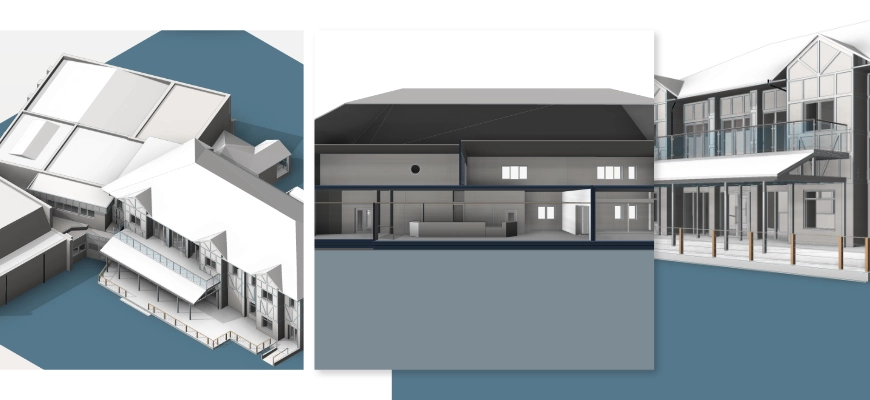
Point cloud capture took three days on site. Turning that into a coordinated, QA’d Revit model, full floor plans, elevations, sections, and the exterior façade detailing, down to surface extrusions and ornamental features took 45 days.
The reason it’s worth mentioning isn’t the numbers themselves, it’s what they represent: the client wasn’t buying a generic model, they were buying a model that matched the building as it actually stood, varying orientations and all, so the renovation design that came after it wasn’t working off assumptions.
That’s the gap between outsourcing to “a Revit modeller” and outsourcing to a partner who treats the survey and the model as one continuous piece of work rather than two jobs handed off between teams that never talk to each other. When those two things are disconnected, small misalignments creep in and don’t surface until someone’s trying to coordinate services around them weeks later.
If your firm is weighing this decision, the honest answer to “should we outsource” isn’t cost. It’s whether your workload is stable enough to justify a full-time seat, or variable enough that flexibility is worth more than ownership. Most firms, if they’re honest with themselves, are the second kind.
If you’re at that point, a deadline outpacing your team’s capacity, or a project with existing-condition complexity you’d rather not model from scratch in-house. Get in touch with Survey2Plan or explore our revit modeling service and send over what you’ve got, whether that’s CAD files, PDFs, or point cloud data. Most enquiries get a clear quote and timeline back within 24 hours, so you’ll know quickly whether it’s the right fit before committing to anything.